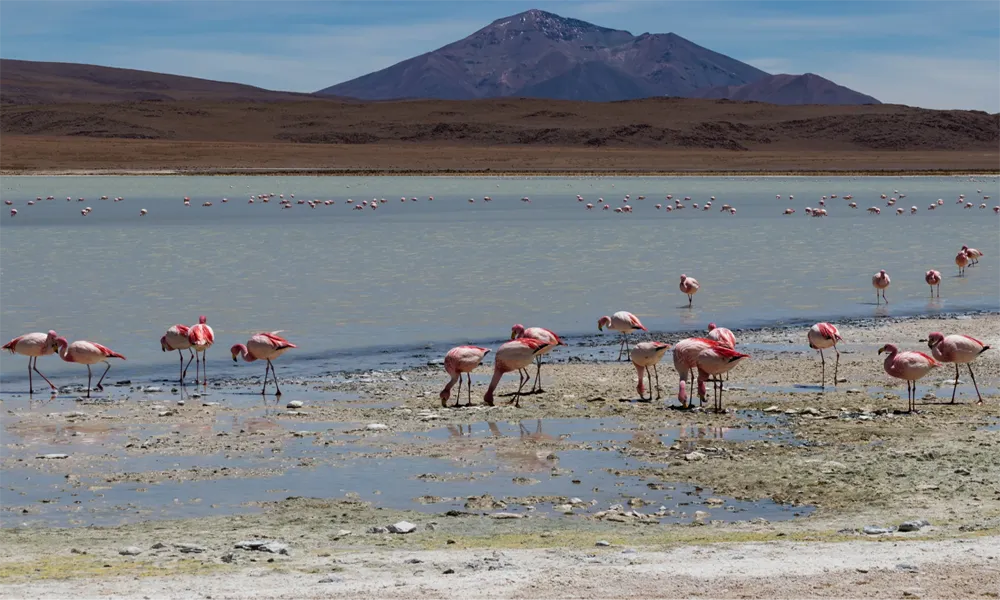

Laguna Hedionda: A high-altitude paradise in Bolivia

Laguna Hedionda is one of the most breathtaking destinations on the Bolivian altiplano, famous for its intense turquoise color, the large number of Andean flamingos that inhabit it, and its surrounding volcanic landscapes. It is located at an approximate altitude of 4,121 meters above sea level, in the southwestern region of Potosí, within the Eduardo Avaroa Andean Fauna National Reserve, one of Bolivia’s most important protected areas.
Despite its name—which comes from the strong sulfurous odor due to its high mineral concentration—Laguna Hedionda is a natural spectacle that combines wildlife, geology, and surreal landscapes.
📍Where is Laguna Hedionda located?
Laguna Hedionda is located in southwestern Bolivia, within the department of Potosí, in the Sud Lípez region, very close to the border with Chile.
Reserve: Eduardo Avaroa Andean Fauna National Reserve
Altitude: approx. 4,100 m above sea level
Access: via tours from Uyuni or San Pedro de Atacama
Visit: included in most 3- and 4-day tours
Its location in a remote environment makes it a place of pristine and relatively untouched landscapes.
🌋Why is it called Laguna Hedionda?
The name “Hedionda” comes from the sulfurous smell emanating from its waters, caused by the high concentration of minerals and sulfur compounds. Although the smell can be faintly detected, it is not unpleasant for most visitors and is part of the natural experience of the place.
This mineral content is precisely what fosters the life of microorganisms, the base of the flamingo food chain.
🌈 Characteristics of Laguna Hedionda
Laguna Hedionda is a shallow salt lake, which allows for clear observation of its colors and wildlife.
Main characteristics:
- Greenish-blue waters
- White edges of salt and minerals
- Shallow bottom
- High concentration of salt and sulfur
- Color changes depending on sunlight
The contrast between the lake, the intense blue sky, and the volcanoes creates an unforgettable Andean landscape.
🦩Wildlife: Home to Andean Flamingos
One of the biggest attractions of Laguna Hedionda is the constant presence of flamingos. Here you can observe:
- Andean Flamingo
- Chilean Flamingo
- James’s Flamingo
These birds feed on microalgae and crustaceans present in the lake. In addition to flamingos, you might see:
- Vicuñas
- Andean foxes
- High-altitude birds
Wildlife observation is conducted without disturbing the environment, always maintaining a safe distance.

⏰ Best time to visit Laguna Hedionda
Dry season (April – November)
- Clear skies
- Best visibility
- Cool but stable weather
- Ideal for photography and wildlife viewing
Rainy season (December – March)
- More vibrant colors
- Greater water availability
- Possible road conditions
🚙 How to get to Laguna Hedionda?
The lagoon is visited exclusively through tours:
From Uyuni:
- 3-day / 2-night tours
- 4-day / 3-night tours
From San Pedro de Atacama:
- 4-day tours crossing the border
Transportation is provided in 4×4 vehicles, essential due to the terrain.
🎒Tips for visiting Laguna Hedionda
- Dress warmly: temperatures are very low.
- Use sunscreen and UV sunglasses.
- Bring water and snacks.
- Walk slowly due to the high altitude.
- Do not feed or approach the animals.
- Respect the guide’s instructions.
❓ Frequently Asked Questions about Laguna Hedionda
1. Why is it called Laguna Hedionda?
It’s due to the strong sulfur smell caused by the high concentration of minerals in the water.
2. Is the altitude dangerous?
At 4,121 meters above sea level, it’s recommended to be acclimatized to avoid altitude sickness.
3. Can you swim in the lagoon?
No, due to its high salinity, smell, and the presence of protected wildlife.
4. Is it included in all tours of the Salar de Uyuni?
Most tours of 3 days or more do include it, especially those that connect with Chile.
5. Is there accommodation nearby?
Overnight stays are generally in basic accommodations or ecolodges in nearby towns like San Juan or Villa Mar.